
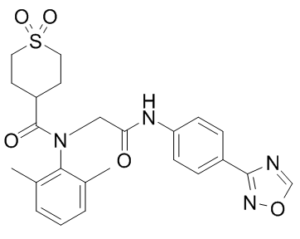
| CAS NO: | 841301-32-4 |
| 规格: | ≥98% |
| 包装 | 价格(元) |
| 5mg | 询价 |
| 10mg | 询价 |
| 25mg | 询价 |
| 50mg | 询价 |
| 100mg | 询价 |
| 250mg | 询价 |
| Molecular Weight (MW) | 482.55 |
|---|---|
| Formula | C24H26N4O5S |
| CAS No. | 841301-32-4 |
| Storage | -20℃ for 3 years in powder form |
| -80℃ for 2 years in solvent | |
| Solubility (In vitro) | DMSO:>150 mg/mL |
| Water: NA | |
| Ethanol: NA | |
| Chemical Name | N-(2-((4-(1,2,4-oxadiazol-3-yl)phenyl)amino)-2-oxoethyl)-N-(2,6-dimethylphenyl)tetrahydro-2H-thiopyran-4-carboxamide 1,1-dioxide |
| Synonyms | ASP-2151; ASP2151; ASP 2151 |
| SMILES Code | O=C(C(CC1)CCS1(=O)=O)N(C2=C(C)C=CC=C2C)CC(NC3=CC=C(C4=NOC=N4)C=C3)=O |
| In Vitro | In vitro activity: Amenamevir a novel class of antiviral agent other than nucleoside compounds, such as aciclovir, valaciclovir and famciclovir. ASP2151 inhibited the in vitro replication of HSV-1 with a mean 50% effective concentration (EC(50)) of 14 ng/ml. Kinase Assay: Amenamevir (formerly known as ASP2151) is a HSV (herpes simplex virus) helicase-primase inhibitor with potent antiviral activity against HSVs with EC50 of 14 ng/mL. Cell Assay: The antiviral activities of Amenamevir (ASP2151) and ACV against HSVs are tested using a plaque reduction assay. Briefly, HEF cells are seeded into multi well plates and incubated until they form a monolayer. After the medium is removed, the cells are infected with HSV-1 or HSV-2, and the plates are further incubated for 1 h at 37°C. The cells are washed twice with maintenance medium and then treated with the test compound (including Amenamevir) until clear plaques appear. The cells are then fixed with 10% formalin in phosphate-buffered saline, stained with a 0.02% crystal violet solution, and the number of plaques is determined under a light microscope. The EC50, which represents the concentration of test compound needed to reduce the plaque number by 50%, is calculated using nonlinear regression analysis with a sigmoid-maximum effect (Emax) model. |
|---|---|
| In Vivo | In the cutaneously HSV-1-infected mouse model, ASP2151 dose dependently suppressed intradermal HSV-1 growth, with the effect reaching a plateau at a dose of 30 mg/kg of body weight/day. The dose fractionation study showed that intradermal HSV-1 titers were below the detection limit in mice treated with ASP2151 at 100 mg/kg/day divided into two daily doses and at 30 or 100 mg/kg/day divided into three daily doses. The intradermal HSV-1 titer correlated with the maximum concentration of drug in serum (C(max)), the area under the concentration-time curve over 24 h (AUC(24h)), and the time during which the concentration of ASP2151 in plasma was above 100 ng/ml (T(>100)). The continuous infusion of ASP2151 effectively decreased intradermal HSV-1 titers below the limit of detection in mice in which the ASP2151 concentration in plasma reached 79 to 145 ng/ml. Our findings suggest that the antiviral efficacy of ASP2151 is most closely associated with the PK parameter T(>100) in HSV-1-infected mice. Based on these results, we propose that a plasma ASP2151 concentration exceeding 100 ng/ml for 21 to 24 h per day provides the maximum efficacy in HSV-1-infected mice. |
| Animal model | Female hairless mice (HOS:HR-1, 7 to 8 weeks old) with HSV-1-infection |
| Formulation & Dosage | Formulated in polyethylene glycol 400 [PEG 400]; 1, 3, 10, 30, or 100 mg/kg/day; orally administered to HSV-1-infected mice (n=5) for 5 days. |
| References | J Dermatol. 2017 Nov;44(11):1219-1227; Antimicrob Agents Chemother. 2013 Mar;57(3):1339-46. |
| 维奥蛋白资源库 - 中文蛋白资源 CopyRight © 2010-2026 |