
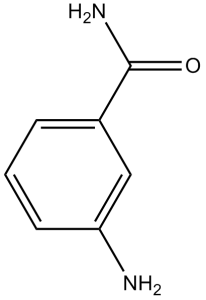
| CAS NO: | 3544-24-9 |
| 规格: | ≥98% |
| 包装 | 价格(元) |
| 100mg | 询价 |
| 500mg | 询价 |
| 1g | 询价 |
| 5g | 询价 |
| 10g | 询价 |
| Molecular Weight (MW) | 136.15 | |
|---|---|---|
| Formula | C7H8N2O | |
| CAS No. | 3544-24-9 | |
| Storage | -20℃ for 3 years in powder form | |
| -80℃ for 2 years in solvent | ||
| Solubility (In vitro) | DMSO: N/A | |
| H2O: ≥ 11.11 mg/mL | ||
| Ethanol: N/A | ||
| Synonyms | 3-Aminobenzamide; PARP-IN-1; 3-ABA; 3-AB |
| In Vitro | In vitro activity: 3-Aminobenzamide (>1 μM) causes more than 95% inhibition of PARP activity without significant cellular toxicity. INO-1001 significantly sensitizes CHO cells by blocking most of the DNA repair occurring between radiation fractions. 3-Aminobenzamide significantly improves endothelial function by enhancing the acetylcholine-induced, endothelium-dependent, nitric oxide mediated vasorelaxation after exposure with 400 μM H2O2 Kinase Assay: PARP activity is measured with a PARP Activity Assay Kit. This method measures relative PARP activity by determining the level of incorporation of 3H-NAD into trichloroacetic acid (TCA) precipitable material in the presence of sheared genomic DNA, which activates PARP. The reaction mixture is added directly to washed cultures in 12-well culture plates and the reaction is allowed to proceed for 60 minutes at 37°C before the cells are removed mechanically, transferred to a microcentrifuge tube, and precipitated with ice-cold 5% TCA. Cell Assay: 3-Aminobenzamide (PARP-IN-1) is a potent inhibitor of PARP with IC50 of appr 50 nM in CHO cells, and acts as a mediator of oxidant-induced myocyte dysfunction during reperfusion. |
|---|---|
| In Vivo | In a db/db (Leprdb/db) mouse model, 3-Aminobenzamide ameliorates diabetes-induced albumin excretion and mesangial expansion, and also decreases diabetes-induced podocyte depletion[3]. 3-Aminobenzamide (1.6 mg/kg via intracerebral injection) prevents NAD+ depletion and improves water maze performance after controlled cortical impact (CCI) in mice |
| Animal model | Mice |
| Formulation & Dosage | 1.6 mg/kg via intracerebral injection |
| References | [1]. Brock WA, et al. Radiosensitization of human and rodent cell lines by INO-1001, a novel inhibitor of poly(ADP-ribose) polymerase. Cancer Lett. 2004 Mar 18;205(2):155-60. [2]. Radovits T, et al. Poly(ADP-ribose) polymerase inhibition improves endothelial dysfunction induced by reactive oxidant hydrogen peroxide in vitro. Eur J Pharmacol. 2007 Jun 14;564(1-3):158-66. [3]. Szabo C, et al. Poly(ADP-ribose) polymerase inhibitors ameliorate nephropathy of type 2 diabetic Leprdb/db mice. Diabetes. 2006 Nov;55(11):3004-12. [4]. Clark RS, et al. Local administration of the poly(ADP-ribose) polymerase inhibitor INO-1001 prevents NAD+ depletion and improves water maze performance after traumatic brain injury in mice. J Neurotrauma. 2007 Aug;24(8):1399-405. |
| 维奥蛋白资源库 - 中文蛋白资源 CopyRight © 2010-2026 |