
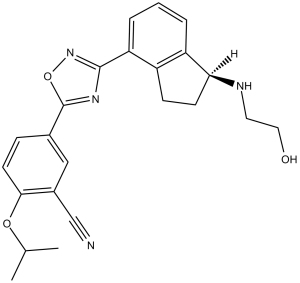
| CAS NO: | 1306760-87-1 |
| 规格: | ≥98% |
| 包装 | 价格(元) |
| 5mg | 询价 |
| 10mg | 询价 |
| 25mg | 询价 |
| 50mg | 询价 |
| 100mg | 询价 |
| 250mg | 询价 |
| 500mg | 询价 |
| Molecular Weight (MW) | 404.46 |
|---|---|
| Formula | C23H24N4O3 |
| CAS No. | 1306760-87-1 |
| Storage | -20℃ for 3 years in powder form |
| -80℃ for 2 years in solvent | |
| Solubility (In vitro) | DMSO: 81 mg/mL (200.3 mM) |
| Water: <1 mg/mL | |
| Ethanol: 10 mg/mL (24.7 mM) | |
| Other info | Chemical Name:
(S)-5-(3-(1-((2-hydroxyethyl)amino)-2,3-dihydro-1H-inden-4-yl)-1,2,4-oxadiazol-5-yl)-2-isopropoxybenzonitrile InChi Key: XRVDGNKRPOAQTN-FQEVSTJZSA-N InChi Code: InChI=1S/C23H24N4O3/c1-14(2)29-21-9-6-15(12-16(21)13-24)23-26-22(27-30-23)19-5-3-4-18-17(19)7-8-20(18)25-10-11-28/h3-6,9,12,14,20,25,28H,7-8,10-11H2,1-2H3/t20-/m0/s1 SMILES Code: N#CC1=CC(C2=NC(C3=CC=CC4=C3CC[C@@H]4NCCO)=NO2)=CC=C1OC(C)C |
| Synonyms | RPC1063; RPC-1063; RPC 1063 |
| In Vitro | In vitro activity: In S1P1R-HEK293T cells, Ozanimod induces sustained S1P1R internalization and degradation. Kinase Assay: Ozanimod is a potent and selective S1P1 and S1P5 receptor agonist with EC50s of 410±160 pM and 11±4.3 nM in [35S]-GTPγS binding, respectively. Cell Assay: Ozanimod(RPC1063) was a specific agonist for S1P1 and S1P5 receptors. The EC50values were 160 ± 60 pM and 410 ± 160 pM for S1P1 receptors in the inhibition of cAMP generation and[35S]-GTPγS binding. The 83% Emax value of ozanimod against S1P5 receptor was 11 ± 4.3 nM. RPC1063 dose-dependently decreased S1P1 receptor re-expression on the cell surface and resulted in near complete and sustained loss of cell surface receptor expression at concentrations above 10 nM in S1P1 receptor-HEK293T cells after 1 h incubation. |
|---|---|
| In Vivo | In vivo, Ozanimod shows high oral bioavailability and volume of distribution. In a MOG-induced EAE mouse model, Ozanimod (3 mg/kg, p.o.) suppresses clinical symptoms. In a rat TNBS model of inflammatory bowel disease, Ozanimod (1.2 mg/kg, p.o.) inhibits clinical and histological disease scores. In a Naive CD4+CD45Rbhi T cell adoptive transfer model, Ozanimod (1.2 mg/kg, p.o.) also significantly reduced disease severity as assessed by measuring the degree of inflammation, gland loss, hyperplasia, neutrophil infiltrate and mucosal thickness. |
| Animal model | MOG-induced EAE model in C57Bl6 mice, TNBS model of inflammatory bowel disease in male Sprague Dawley rats, and Naive CD4+CD45Rbhi T cell adoptive transfer model in SCID mice |
| Formulation & Dosage | Dissolved in 5% DMSO, 5% Tween-20, 90% 0.1N HCl; 0.1-3 mg/kg; oral givage |
| References | Br J Pharmacol. 2016 Jun;173(11):1778-92 |
| 维奥蛋白资源库 - 中文蛋白资源 CopyRight © 2010-2026 |