| CAS NO: | 155213-67-5 |
| 规格: | ≥98% |
| 包装 | 价格(元) |
| 10mg | 询价 |
| 25mg | 询价 |
| 50mg | 询价 |
| 100mg | 询价 |
| 250mg | 询价 |
| 500mg | 询价 |
| 1g | 询价 |
| Molecular Weight (MW) | 720.94 |
|---|---|
| Formula | C37H48N6O5S2 |
| CAS No. | 155213-67-5 (Ritonavir); |
| Storage | -20℃ for 3 years in powder form |
| -80℃ for 2 years in solvent | |
| Solubility (In vitro) | DMSO: 100 mg/mL (138.7 mM) |
| Water: <1 mg/mL | |
| Ethanol: 3 mg/mL (4.16 mM) | |
| Solubility (In vivo) | 30% PEG400+0.5% Tween80+5% propylene glycol: 30 mg/mL |
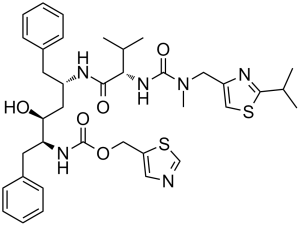
| Synonyms | ABT-538; A 84538; Norvir; ABT538; A-84538; Norvir Sec; 538, ABT; Ritonavir; ABT 538; Chemical Name: 1,3-thiazol-5-ylmethyl N-[(2S,3S,5S)-3-hydroxy-5-[[(2S)-3-methyl-2-[[methyl-[(2-propan-2-yl-1,3-thiazol-4-yl)methyl]carbamoyl]amino]butanoyl]amino]-1,6-diphenylhexan-2-yl]carbamate InChi Key: NCDNCNXCDXHOMX-UHFFFAOYSA-N InChi Code: InChI=1S/C37H48N6O5S2/c1-24(2)33(42-36(46)43(5)20-29-22-49-35(40-29)25(3)4)34(45)39-28(16-26-12-8-6-9-13-26)18-32(44)31(17-27-14-10-7-11-15-27)41-37(47)48-21-30-19-38-23-50-30/h6-15,19,22-25,28,31-33,44H,16-18,20-21H2,1-5H3,(H,39,45)(H,41,47)(H,42,46) SMILES Code: CC(C)C1=NC(=CS1)CN(C)C(=O)NC(C(C)C)C(=O)NC(CC2=CC=CC=C2)CC(C(CC3=CC=CC=C3)NC(=O)OCC4=CN=CS4)O |
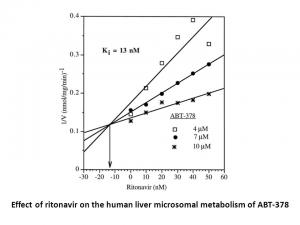
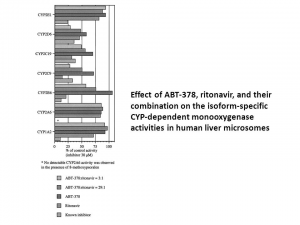
| In Vitro | In vitro activity: Ritonavir is a very potent inhibitor of CYP3A4 mediated testosterone 6β-hydroxylation with mean Ki of 19 nM and also inhibits tolbutamide hydroxylation with IC50 of 4.2 μM. Ritonavir is found to be a potent inhibitor of CYP3A-mediated biotransformations (nifedipine oxidation with IC50 of 0.07 mM, 17alpha-ethynylestradiol 2-hydroxylation with IC50 of 2 mM; terfenadine hydroxylation with IC50 of 0.14 mM). Ritonavir is also found to be an inhibitor of the reactions mediated by CYP2D6 (IC50 = 2.5 mM) and CYP2C9/10 (IC50 = 8.0 mM). Ritonavir results in an increase in cell viability in uninfected human PBMC cultures. Ritonavir markedly decreases the susceptibility of PBMCs to apoptosis correlated with lower levels of caspase-1 expression, decreases in annexin V staining, and reduces caspase-3 activity in uninfected human PBMC cultures. Ritonavir inhibits induction of tumor necrosis factor (TNF) production by PBMCs and monocytes in a time- and dose-dependent manner at nontoxic concentrations. Ritonavir inhibits p-glycoprotein-mediated extrusion of saquinavir with an IC50 of 0.2 μM, indicating a high affinity of ritonavir for p-glycoprotein. Ritonavir inhibits human liver microsomal metabolism of ABT-378 potently with Ki of 13 nM. Ritonavir combined with ABT-378 (at 3:1 and 29:1 ratios) inhibits CYP3A (IC50 = 1.1 and 4.6 μM), albeit less potently than Ritonavir (IC50 = 0.14 μM). Kinase Assay: Ritonavir (ABT 538) is an inhibitor of CYP3A4 mediated testosterone 6β-hydroxylation with mean Ki of 19 nM and also inhibits tolbutamide hydroxylation with IC50 of 4.2 μM. Ritonavir (ABT 538) is found to be a potent inhibitor of CYP3A-mediated biotransformations (nifedipine oxidation with IC50 of 0.07 mM, 17alpha-ethynylestradiol 2-hydroxylation with IC50 of 2 mM; terfenadine hydroxylation with IC50 of 0.14 mM). Ritonavir is also an inhibitor of the reactions mediated by CYP2D6 (IC50=2.5 mM) and CYP2C9/10 (IC50=8.0 mM). Cell Assay: Ritonavir results in an increase in cell viability in uninfected human PBMC cultures. Ritonavir markedly decreases the susceptibility of PBMCs to apoptosis correlated with lower levels of caspase-1 expression, decreases in annexin V staining, and reduces caspase-3 activity in uninfected human PBMC cultures. Ritonavir inhibits induction of tumor necrosis factor (TNF) production by PBMCs and monocytes in a time- and dose-dependent manner at nontoxic concentrations. Ritonavir inhibits p-glycoprotein-mediated extrusion of saquinavir with an IC50 of 0.2 μM, indicating a high affinity of ritonavir for p-glycoprotein. Ritonavir inhibits human liver microsomal metabolism of ABT-378 potently with Ki of 13 nM. Ritonavir combined with ABT-378 (at 3:1 and 29:1 ratios) inhibits CYP3A (IC50=1.1 and 4.6 μM), albeit less potently than Ritonavir (IC50=0.14 μM). |
|---|---|
| In Vivo | |
| Animal model | |
| Formulation & Dosage | |
| References | Br J Clin Pharmacol. 1997 Aug;44(2):190-4; J Pharmacol Exp Ther. 1996 Apr;277(1):423-31. |
|
|
| Biological Activity Ritonavir |
| 维奥蛋白资源库 - 中文蛋白资源 CopyRight © 2010-2026 |