
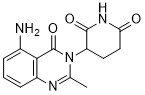
| CAS NO: | 1015474-32-4 |
| 规格: | ≥98% |
| 包装 | 价格(元) |
| 2mg | 询价 |
| 5mg | 询价 |
| 10mg | 询价 |
| 25mg | 询价 |
| 50mg | 询价 |
| 100mg | 询价 |
| Molecular Weight (MW) | 286.29 |
|---|---|
| Formula | C14H14N4O3 |
| CAS No. | 1015474-32-4 (free base); 1398053-45-6 (HCl); |
| Storage | -20℃ for 3 years in powder form |
| -80℃ for 2 years in solvent | |
| Solubility (In vitro) | DMSO:>100 mg/mL |
| Water:<1mg/mL | |
| Ethanol: <1mg/mL | |
| SMILES Code | O=C(C(N1C(C)=NC2=C(C(N)=CC=C2)C1=O)CC3)NC3=O |
| Synonyms | Avadomide; CC 122; CC-122; CC122 Chemical Name: 3-(5-amino-2-methyl-4-oxoquinazolin-3(4H)-yl)piperidine-2,6-dione Exact Mass: 286.1066 |
| In Vitro | In vitro activity: C-122 is a novel agent for DLBCL with antitumor and immunomodulatory activity. In DLBCL cell lines, It binds CRBN and induces degradation or short hairpin RNA-mediated knockdown of Aiolos and Ikaros which correlates with increased transcription of interferon (IFN)-stimulated genes independent of IFN-α, -β, and -γ production and/or secretion and results in apoptosis in both activated B-cell (ABC) and germinal center B-cell DLBCL cell lines. CRBN is the molecular target of CC-122, CC-122 binding to CRBN recruits Aiolos/Ikaros to CRL4CRBN, and E3 ligase enzymatic activity is necessary for ubiquitination of Aiolos and Ikaros and thus their proteasomal degradation induced by CC-122. CC-122 induces IFN-regulated proteins and its mediated effects on the IFN pathway is independent of autocrine type I and II IFN secretion and signaling. Kinase Assay: CC-122 is a novel agent for DLBCL with antitumor and immunomodulatory activity.CC-122 binds CRBN and degrades Aiolos and Ikaros resulting in a mimicry of IFN signaling and apoptosis in DLBCL. In vitro: CC122 inhibits proliferation and induces apoptosis in ABC and GCB DLBCL. In DLBCL cell lines, CC122-induced degradation or short hairpin RNA-mediated knockdown of Aiolos and Ikaros correlates with increased transcription of interferon (IFN)-stimulated genes independent of IFN-α, -β, and -γ production and/or secretion and results in apoptosis in both activated B-cell (ABC) and germinal center B-cell DLBCL. Cell Assay: Diffuse Large B-Cell Lymphoma are cultured in RPMI-1640 containing 10-20% fetal bovine serum, 1% Penicillin/Streptomycin and 1 mM sodium pyruvate. 2×10⁴ cells are plated per well in media containing either DMSO or various concentrations of CC-122. Cells are cultured for 5 days at 37 degrees Celsius after which tritiated thymidine is added to the cell culture for the final 6 hours. Cells are subsequently harvested onto filter plates. After the plates have dried, scintillation fluid is added to the plates and read on a Top-count reader. |
|---|---|
| In Vivo | CC-122 reduces tumor growth in xenograft models established from ABC- and GCB-DLBCL cell lines, and stimulates IL-2 production in primary T cells. Also, in a single-arm CC-122 clinical trial, exposure to CC-122 reduced expression levels of Aiolos and Ikaros in each patient by 25% to 50% demonstrating the utility of these 2 proteins as pharmacodynamic markers of CC-122 |
| Animal model | CB-17 SCID mice |
| Formulation & Dosage | 0.5% carboxymethyl cellulose: 0.25% Tween-80 in deionized water;3 or 30 mg/kg;p.o. |
| References | Blood. 2015 Aug 6;126(6):779-89. |
| 维奥蛋白资源库 - 中文蛋白资源 CopyRight © 2010-2026 |